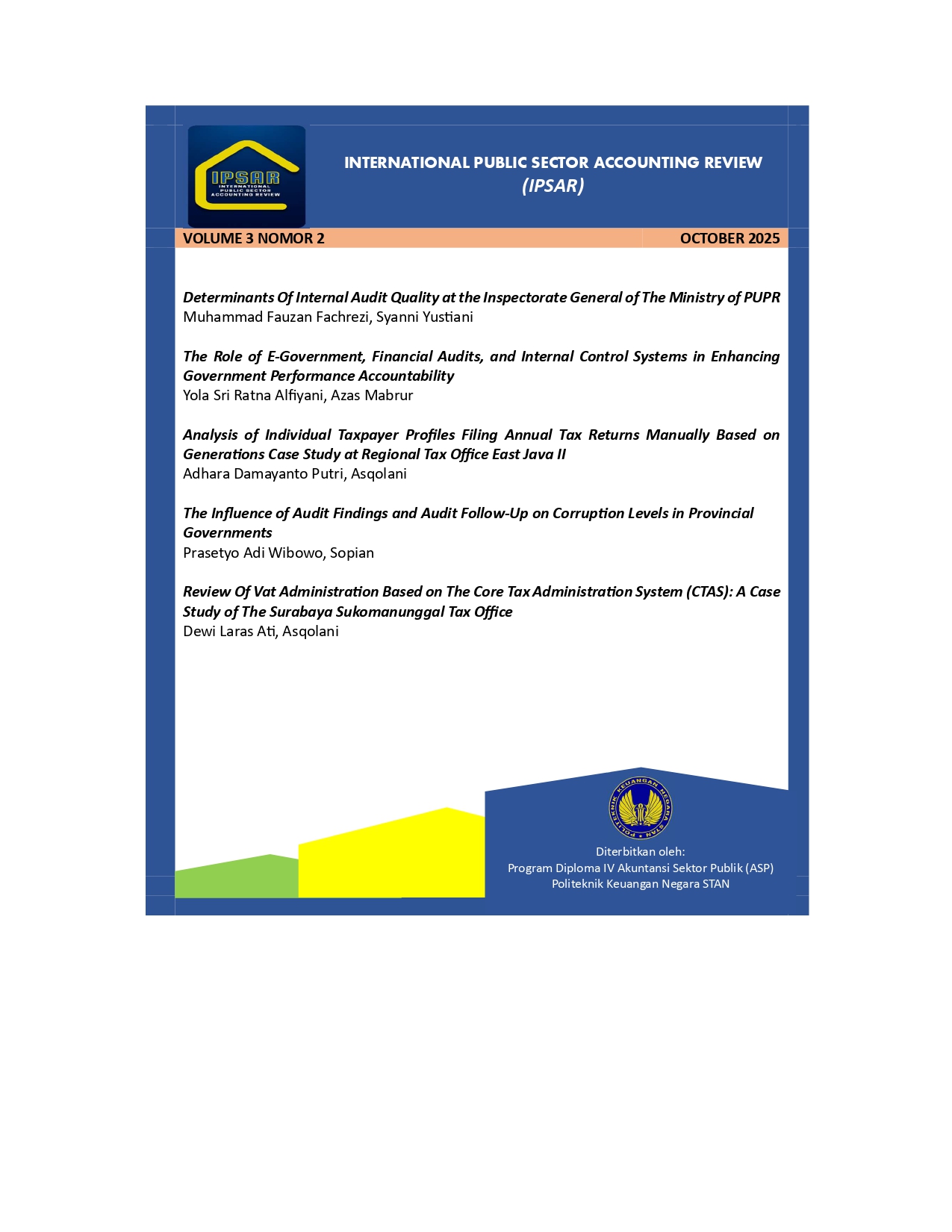
The Influence of Audit Findings and Audit Follow-Up on Corruption Levels in Provincial Governments
DOI:
https://doi.org/10.31092/ipsar.v3i2.3736Keywords:
Audit Finding, Audit Follow-Up, Corruption, Provincial GovernmentAbstract
This study aims to obtain empirical evidence regarding the influence of audit findings and audit follow-up on corruption levels in provincial governments in Indonesia. Audit findings are analyzed into two categories: internal control weaknesses and non-compliance with laws and regulations. The method applied in this study is a quantitative, purposive sampling approach across 34 provinces in Indonesia during the 2021–2023 period, yielding 102 observations. The secondary data sources were obtained from ICW reports, IHPS BPK, and BPS publications. The data analysis used in this study was multiple regression with a random effects model. The results show that internal control weaknesses has a significant positive effect on corruption levels, and audit follow-up has a significant negative effect on corruption levels. Meanwhile, non-compliance with laws and regulations does not have a significant effect on corruption levels. These findings indicate that weaknesses in internal control systems can create opportunities for corruption, and effective follow-up on audit results can suppress such practices. In contrast, non-compliance with laws and regulations makes it difficult to verify corruption due to information asymmetry.
Downloads
Published
How to Cite
Issue
Section
License
Copyright (c) 2025 Sopian Sopian, Prasetyo Adi Wibowo

This work is licensed under a Creative Commons Attribution-ShareAlike 4.0 International License.
Creative Commons Attribution-ShareAlike 4.0 International
This license requires that reusers give credit to the creator. It allows reusers to distribute, remix, adapt, and build upon the material in any medium or format, even for commercial purposes. If others remix, adapt, or build upon the material, they must license the modified material under identical terms.