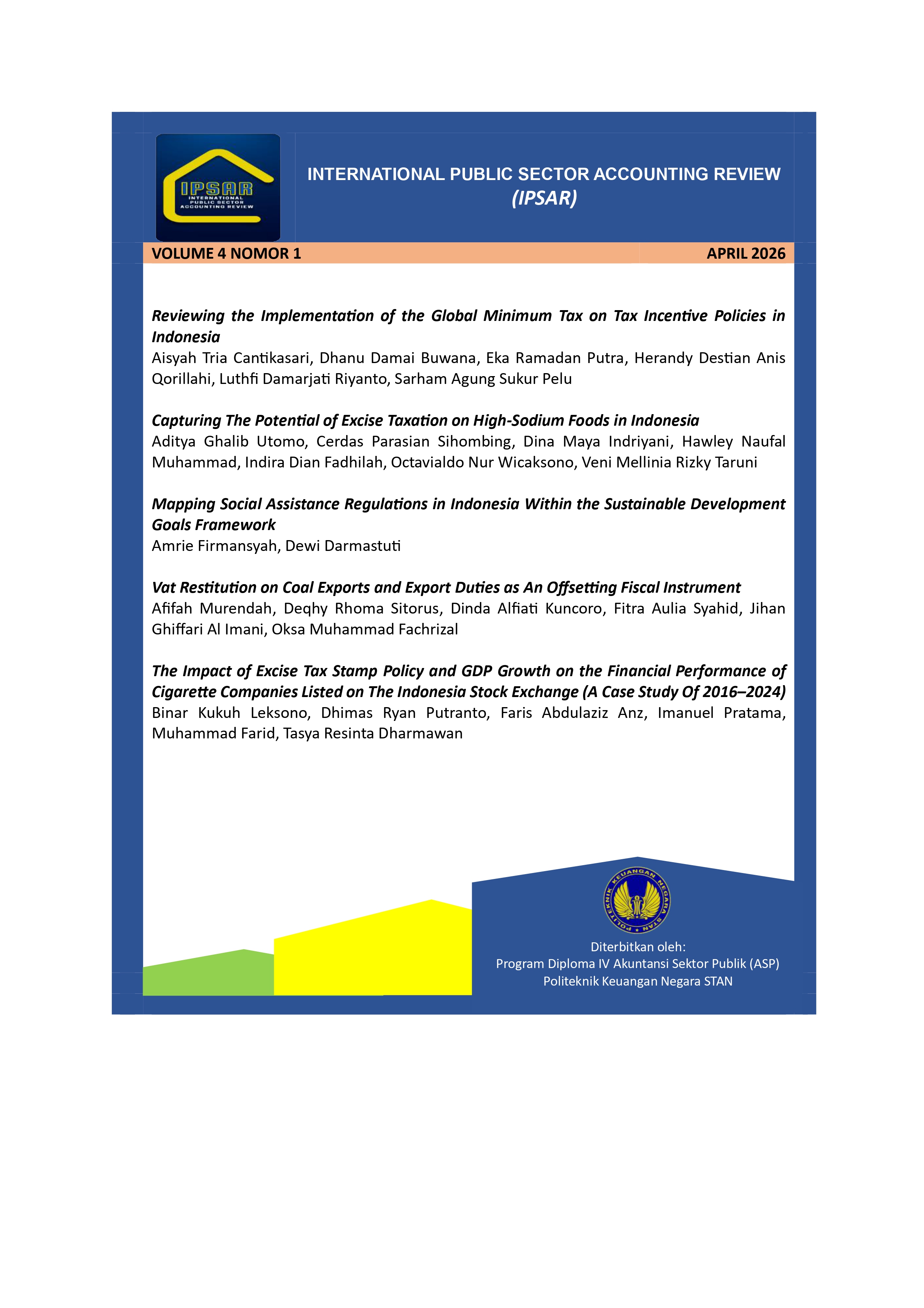
Capturing the Potential of Excise Taxation on High-Sodium Foods in Indonesia
DOI:
https://doi.org/10.31092/ipsar.v4i1.3899Keywords:
excise tax, high-sodium food, negative externalities, public health, government revenueAbstract
The Free Nutritious Meals Program (Program Makan Bergizi Gratis/MBG) represents one of the Indonesian government's strategic national policies aimed at improving human capital through nutritional interventions for students. However, the effectiveness of this program is strongly influenced by the dietary consumption patterns of the population, particularly the high intake of sodium that may contribute to various non-communicable diseases. Data from Survei Konsumsi Makanan Individu indicate that the average salt consumption of Indonesians reaches 6.68 grams per day, exceeding the limit recommended by the World Health Organization (WHO) of less than 5 grams per day. Excessive sodium consumption has been shown to correlate with the increasing prevalence of hypertension, cardiovascular diseases, and stroke, which ultimately generate negative externalities in the form of rising national healthcare expenditures. From a fiscal perspective, this condition opens an opportunity to introduce excise taxation as an instrument to control consumption while simultaneously expanding the government’s revenue base. This study aims to analyze the potential for extending excise taxation to high-sodium food products in Indonesia as a mechanism for both consumption control and revenue diversification. The research employs a qualitative approach using a literature review method by examining regulatory frameworks, sodium consumption data, and policy practices implemented in several countries. The findings indicate that high-sodium food products possess characteristics consistent with excisable goods as stipulated in Law Number 39 of 2007 on Excise. A simple simulation suggests that imposing excise taxes on instant noodles and salty snack products could potentially generate approximately IDR 6.6 trillion in annual state revenue while also creating a price signal that encourages the reduction of high-sodium food consumption. Therefore, the extension of excise taxation on high-sodium foods may provide a double dividend in the form of non-communicable disease control and the strengthening of the government’s revenue base
Downloads
Published
How to Cite
Issue
Section
License
Copyright (c) 2026 Cerdas Parasian Sihombing, Aditya Ghalib Utomo, Dina Maya Indriyani, Hawley Naufal Muhammad, Indira Dian Fadhilah, Octavialdo Nur Wicaksono, Veni Mellinia Rizky Taruni

This work is licensed under a Creative Commons Attribution-ShareAlike 4.0 International License.
Creative Commons Attribution-ShareAlike 4.0 International
This license requires that reusers give credit to the creator. It allows reusers to distribute, remix, adapt, and build upon the material in any medium or format, even for commercial purposes. If others remix, adapt, or build upon the material, they must license the modified material under identical terms.