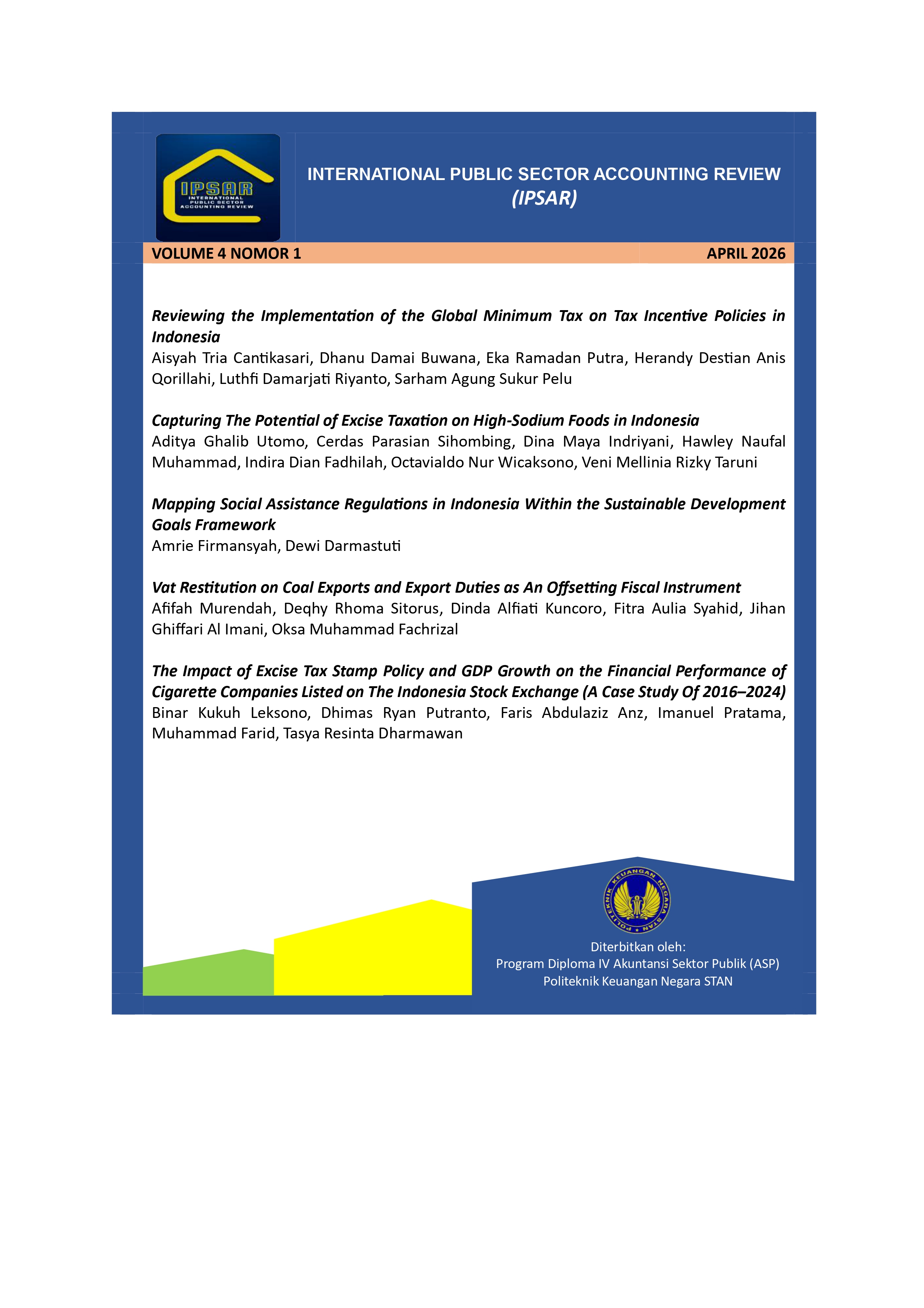
MAPPING SOCIAL ASSISTANCE REGULATIONS IN INDONESIA WITHIN THE SUSTAINABLE DEVELOPMENT GOALS FRAMEWORK
DOI:
https://doi.org/10.31092/ipsar.v4i1.3904Keywords:
Social Assistance, Regulation, Scoping Review, Sustainable DevelopmentAbstract
Social assistance is a key policy instrument for poverty alleviation, inequality reduction, and social welfare enhancement, and it has increasingly been positioned within the broader agenda of sustainable development. This study aims to map social assistance regulations in Indonesia within the Sustainable Development Goals (SDGs) framework to examine the policy position, regulatory direction, and level of integration of social assistance as a sustainable development instrument. This study employs a scoping review approach, analyzing relevant global and national regulations, including the 2030 Agenda for Sustainable Development, national development planning regulations, and sectoral and technical social welfare regulations. The scoping review process is used to identify, classify, and synthesize the characteristics and regulatory focus of social assistance across different governance levels. The findings indicate that social assistance in Indonesia has been normatively and strategically positioned as part of sustainable development, particularly through its integration into long-term and medium-term national development planning frameworks. However, the linkage between social assistance regulations and the SDGs framework at the implementation level remains largely implicit and has not been systematically translated into specific SDG targets and indicators. Existing regulations tend to emphasize administrative governance, delivery mechanisms, and fiscal accountability, while the contribution of social assistance to sustainable development outcomes is not explicitly articulated. These findings highlight the importance of mapping social assistance regulations within the SDGs framework to strengthen policy coherence and support the formulation of social assistance policies that are more effectively integrated with Indonesia's sustainable development agenda.
Downloads
Published
How to Cite
Issue
Section
License
Copyright (c) 2026 Amrie Firmansyah, Dewi Darmastuti

This work is licensed under a Creative Commons Attribution-ShareAlike 4.0 International License.
Creative Commons Attribution-ShareAlike 4.0 International
This license requires that reusers give credit to the creator. It allows reusers to distribute, remix, adapt, and build upon the material in any medium or format, even for commercial purposes. If others remix, adapt, or build upon the material, they must license the modified material under identical terms.