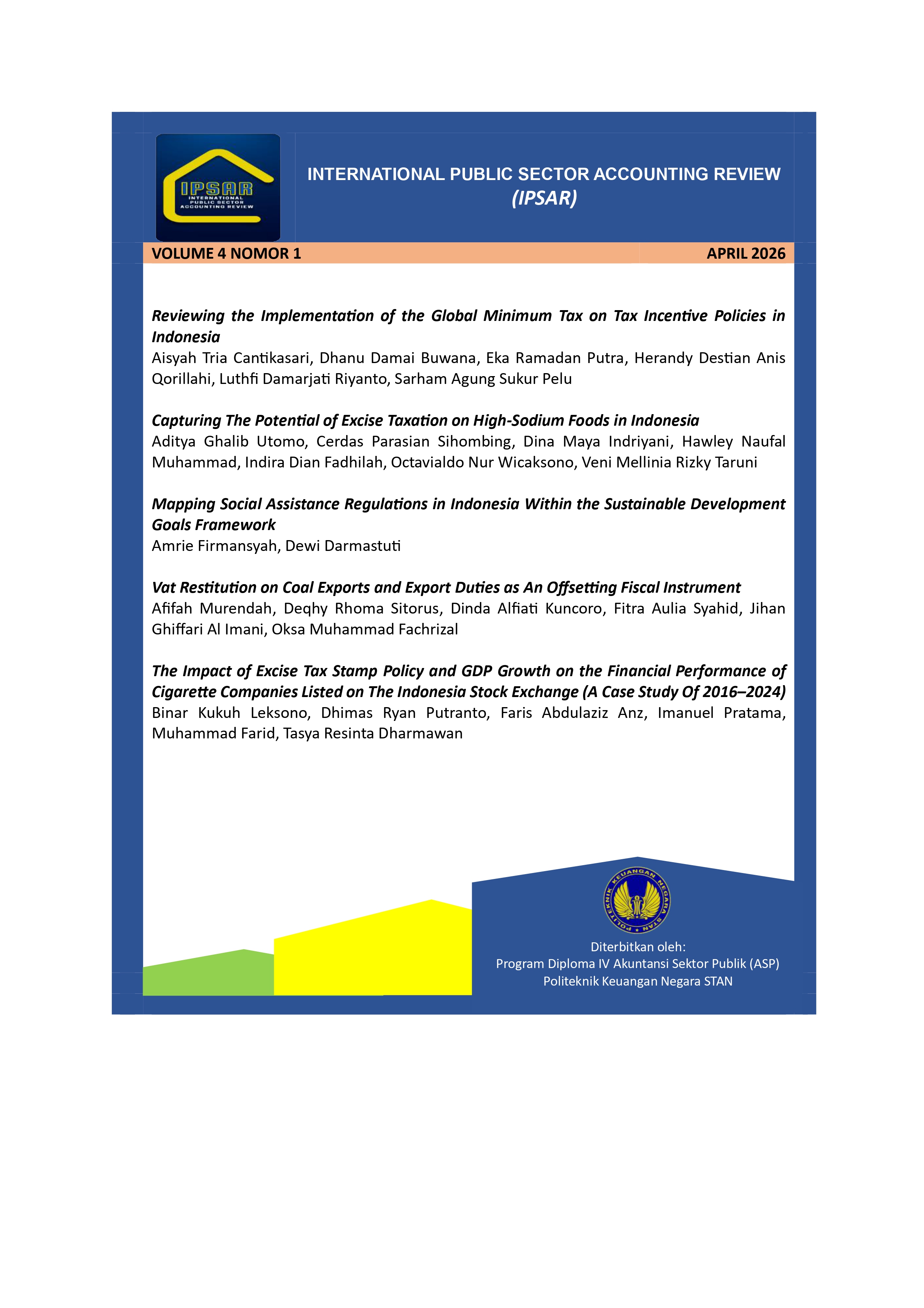
VAT RESTITUTION ON COAL EXPORTS AND EXPORT DUTIES AS AN OFFSETTING FISCAL INSTRUMENT
DOI:
https://doi.org/10.31092/ipsar.v4i1.3907Keywords:
coal, corporate income tax, exports, export duty, Value Added Tax (VAT), VAT refundsAbstract
The designation of coal as a Taxable Goods through Law Number 11 of 2020 on Job Creation fundamentally altered the Value Added Tax (VAT) mechanism for export-oriented coal mining companies. Because coal exports are subject to a 0% VAT rate, Input Tax consistently exceeds Output Tax, creating a structural overpayment condition that entitles companies to recurring VAT refunds (restitution). This study analyzes the magnitude of VAT restitution following this policy change, quantifies its impact on corporate income tax (CIT), evaluates export duties as a fiscal instrument to offset the resulting revenue pressure on the state, and benchmarks Indonesia's planned export duty rate against international comparators.
Using a descriptive quantitative approach through secondary data analysis, this study examines audited financial statements of four publicly listed coal companies: PT Harum Energy Tbk (HRUM), PT Adaro Andalan Indonesia Tbk (AADI), PT Adaro Energy Indonesia Tbk (ADRO), and PT Indo Tambangraya Megah Tbk (ITMG) for fiscal years 2023 and 2024. Total VAT restitution received increased by 127.7%, from USD 236.76 million in 2023 to USD 539.05 million in 2024. Paradoxically, the Taxable Good designation also raised CIT revenue by USD 118.59 million in 2024 (as Input Tax can no longer be expensed), but the net fiscal impact on the state remains negative at USD 420.46 million. A simulation across three tariff scenarios shows that a 2.5% export duty covers only 31.6% of restitution, while a 5% rate covers 63.2%. The minimum rate required for full fiscal break-even is 7.92%. Unlike Russia, which imposed export duties of 4%–7% and experienced declining competitiveness, Indonesia benefits from zero import tariffs in China and across ASEAN, providing a competitive buffer capable of absorbing a higher export duty without threatening export volumes. Export duties therefore represent a viable multifunctional fiscal instrument, but require tariff calibration that exceeds the 1%–5% range currently under policy consideration.
Keywords: Value Added Tax (VAT), VAT refunds, coal, exports, export duty, corporate income tax.
Downloads
Published
How to Cite
Issue
Section
License
Copyright (c) 2026 Dinda Alfiati Kuncoro, Murendah Afifah, Sitorus Deqhy Rhoma, Syahid Fitra Aulia, Al Imani Jihan Ghiffari, Fachrizal Oksa Muhammad

This work is licensed under a Creative Commons Attribution-ShareAlike 4.0 International License.
Creative Commons Attribution-ShareAlike 4.0 International
This license requires that reusers give credit to the creator. It allows reusers to distribute, remix, adapt, and build upon the material in any medium or format, even for commercial purposes. If others remix, adapt, or build upon the material, they must license the modified material under identical terms.