THE IMPACT OF EXCISE TAX STAMP POLICY AND GDP GROWTH ON THE FINANCIAL PERFORMANCE OF CIGARETTE COMPANIES LISTED ON THE INDONESIA STOCK EXCHANGE (A CASE STUDY OF 2016–2024)
DOI:
https://doi.org/10.31092/ipsar.v4i1.3909Keywords:
Transmission Mechanism, Tobacco Excise Tax, Business Resilience, Downtrading Phenomenon, COVID-19 PandemicAbstract
This study aims to deeply explore the transmission mechanism of the Tobacco Excise Tax (CHT) tariff increase policy on business resilience and profitability across different tiers of the cigarette industry in Indonesia. Employing a qualitative descriptive method, this study analyzes secondary data on four publicly listed companies: PT Gudang Garam Tbk (GGRM), PT HM Sampoerna Tbk (HMSP), PT Wismilak Inti Makmur Tbk (WIIM), and PT Indonesian Tobacco Tbk (ITIC). The selection of the 2016–2024 research period captures two crucial phases: economic stability in the four years prior to the COVID-19 pandemic (2016–2019) and the disruption to post-pandemic recovery phase (2020–2024). This research highlights a phenomena gap between positive national Gross Domestic Product (GDP) growth and the profitability anomaly in the tobacco industry. Qualitative findings indicate that the transmission of the excise tax burden into Retail Selling Prices triggers a structural market shift. Increases in post-pandemic GDP do not reflect equitable purchasing power, thereby driving the downtrading phenomenon. Consequently, Tier 1 issuers (GGRM and HMSP) experience significant profit margin pressure, while Tier 2 and substitute product issuers (WIIM and ITIC) find resilience momentum from this consumer shift. The implication of this research comprehensively maps the structural dynamics of the tobacco industry in responding to the dual pressures of fiscal regulation and purchasing power polarization.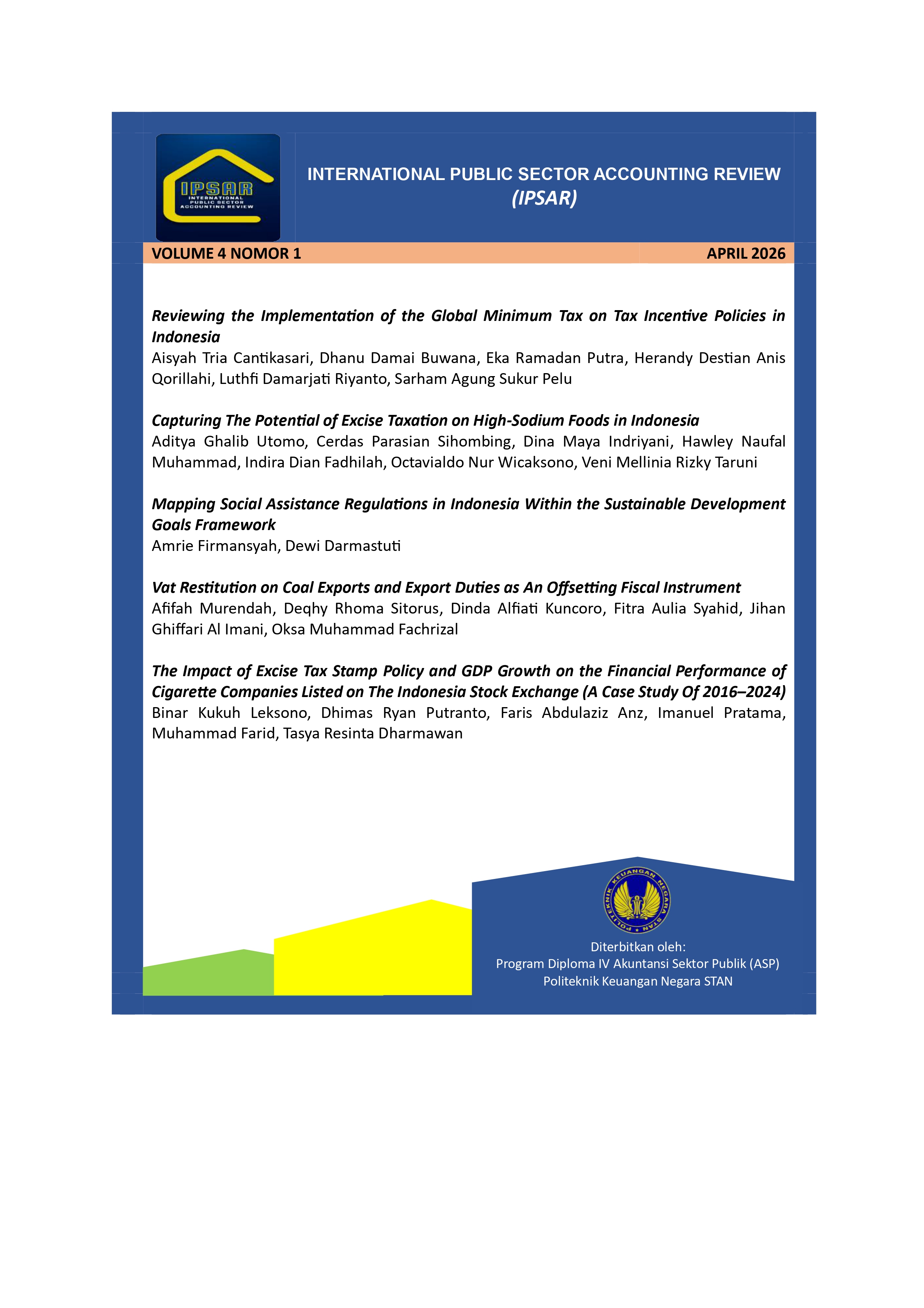
Downloads
Published
2026-05-23
How to Cite
Dharmawan, T. R., Leksono, B. K., Putranto, D. R., Anz, F. A., Pratama, I., & Farid, M. (2026). THE IMPACT OF EXCISE TAX STAMP POLICY AND GDP GROWTH ON THE FINANCIAL PERFORMANCE OF CIGARETTE COMPANIES LISTED ON THE INDONESIA STOCK EXCHANGE (A CASE STUDY OF 2016–2024). IPSAR (International Public Sector Accounting Review), 4(1). https://doi.org/10.31092/ipsar.v4i1.3909
Issue
Section
Articles
License
Copyright (c) 2026 Tasya Resinta Dharmawan, Binar Kukuh Leksono, Dhimas Ryan Putranto, Faris Abdulaziz Anz, Imanuel Pratama, Muhammad Farid

This work is licensed under a Creative Commons Attribution-ShareAlike 4.0 International License.
Creative Commons Attribution-ShareAlike 4.0 International
This license requires that reusers give credit to the creator. It allows reusers to distribute, remix, adapt, and build upon the material in any medium or format, even for commercial purposes. If others remix, adapt, or build upon the material, they must license the modified material under identical terms.
BY Credit must be given to you, the creator.
SA Adaptations must be shared under the same terms.