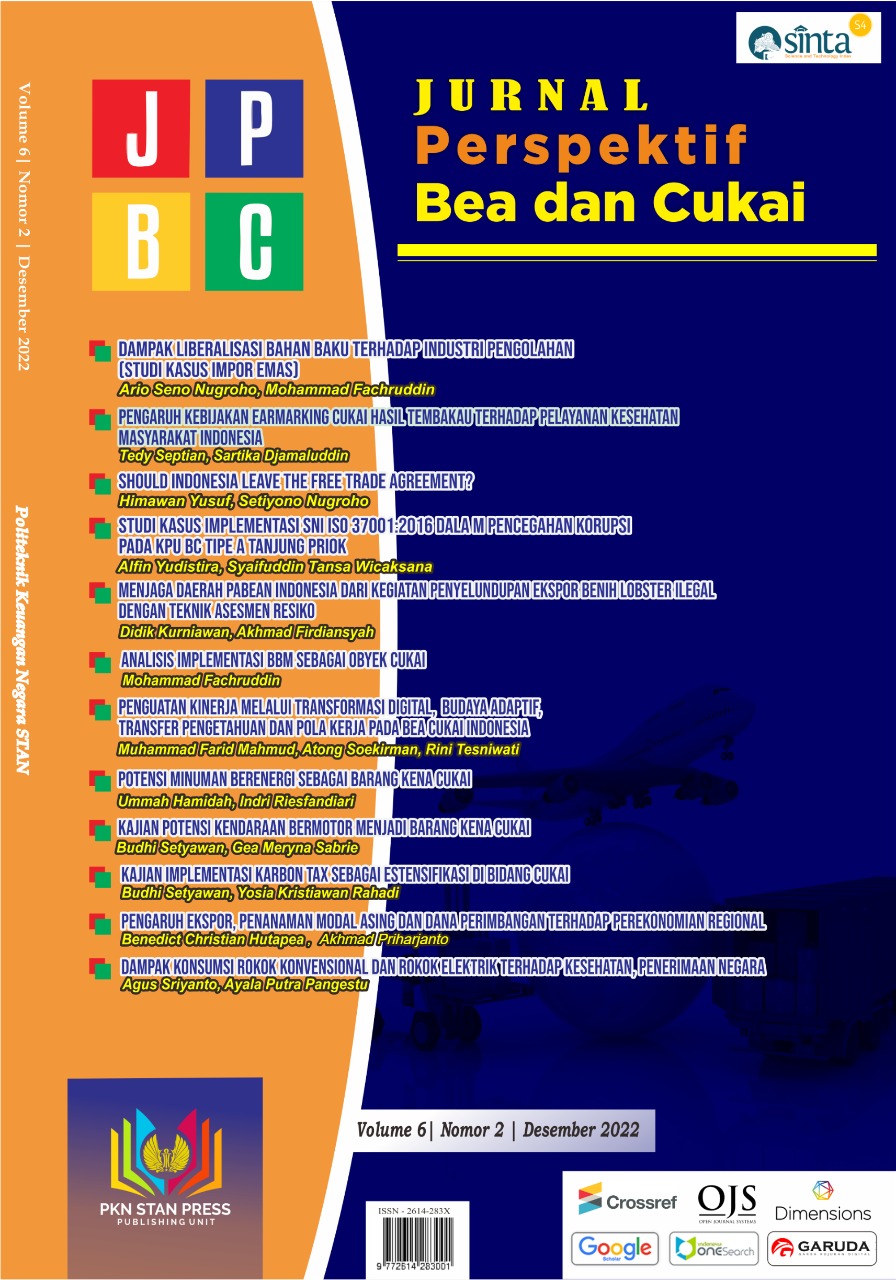
PENGUATAN KINERJA MELALUI TRANSFORMASI DIGITAL, BUDAYA ADAPTIF, TRANSFER PENGETAHUAN DAN POLA KERJA PADA BEA CUKAI INDONESIA
DOI:
https://doi.org/10.31092/jpbc.v6i2.1776Abstract
Di lingkungan Bea Cukai Indonesia, proses transformasi layanan publik telah dilakukan dalam beberapa tahun terakhir dalam rangka mendongkrak kinerja organisasi. Faktanya kinerja masih perlu ditingkatkan. Beberapa penelitian menyimpulkan bahwa kinerja organisasi dipengaruhi oleh budaya, pola kerja dan transfer pengetahuan. Makalah penelitian ini mengkaji dan memperluas pemahaman tentang dampak budaya organisasi adaptif, transfer pengetahuan dan pola kerja adaptif dalam mendorong transformasi digital untuk meningkatkan kinerja organisasi, mengembangkan program budaya dan pilihan pola kerja sebagai strategi untuk meningkatkan kinerja selama transformasi digital. Penelitian ini menggunakan pendekatan mix method, metode kuantitatif untuk menguji hipotesis, responden mewakili Bea dan Cukai Indonesia. Pendekatan kualitatif dengan observasi dan wawancara sebagai konfirmasi dan pendalaman penelitian. Temuan penelitian ini adalah: budaya organisasi memainkan peran penting dalam transformasi digital untuk mendorong kinerja, terutama nilai fokus pemangku kepentingan, kolaborasi dan pengembangan diri. Pola kerja adaptif penting untuk mempengaruhi transfer pengetahuan, mendorong transformasi dan kinerja digital, dan transformasi digital dapat memediasi budaya organisasi adaptif dan transfer pengetahuan dalam meningkatkan kinerja organisasi.
References
Adriana A. Davidescu, Simona-Andreea A. Andreea P. dan Ionut Casuneanu (2020), Work Flexibility, Job Satisfaction, and Job Performance among Romanian Employees: Implications for Sustainable Human Resource Management, Sustainability Journal, 2020, hal 1-53.
Alavi, M. and Leidner, D.E. (2001), Review: Knowledge Management and Knowledge Management Systems: Conceptual Foundations and Research Issues. MIS Quarterly. (25:1). hal 107-136.
Aldrich, H. E., & Ruef, M. (2006), Organizations evolving, 2nd ed., Sage Publications Ltd, 750 First Street NE, Washington DC, 132-178.
Alvesson, Mats. (2002), Understanding Organizational Culture, Administrative Science Quarterly, 48(1):133.
Andreani, F dan Wijayanty D (2014), The Influence of Service Performance on Customer Satisfaction of Bank Central Asia in Surabaya, International Journal of Advances in Management and Economics, ISSN: 2278-3369, hal. 57-64.
Andrew Grainger, (2016), Customs management in multinational companies, World Customs Journal, Volume 10, Number 2, hal 18.
Ang, James B. (2018), Cultural Heritage and Innovation, Bulletin of Monetary Economics and Banking, Vol. 21, No. 2 (2018), hal 141 – 148.
Argote L, Ingram P. (2010), Knowledge transfer: a basis for competitive advantage in firms, Organisational Behaviour and Human Decision Processes. Vol.82 No.1, hal 150-169.
Balandina, Galina V, Yuriy Yu Ponomarev, Sergey G Sinelnikov-Murylev (2018), Customs Administration in Russia: Directions of Improvement, Economic Policy, Published by Oxford University Press, hal 10.
Barney, J. B., & Hesterly, W. S. (2015), Strategic Management and Competitive Advantage, Person/Prentice Hall, hal 52.
Blocher, Edward J., Kung H Chen and Thomas W. Lin (2005). Cost Management: A Stategic Emphasis. International Edition. New York: McGraw-Hill Companies, Inc, hal 12-13.
Bose, R. (2009). Advanced analytics: opportunities and challenges.Industrial Management & Data Systems, Vol. 109(2), pp. 155–172.
Cameron S. Kim and Quinn E. Robert, (2006), Diagnosing and Changin Organizational Culture : Based on the Competing Values Framework, Third Edition, hal 1-59.
Christy MK Cheung, and Dimple Thadani, (2012), The impact of electronic word-of-mouth communication: A literature analysis and integrative model, Decision Support Systems, Published by Elsevier, hal 461-470.
Cho, E. (2020). Examining boundaries to understand the impact of COVID-19 on vocational behaviors. Journal of Vocational Behavior, hal 1-3. https://doi.org/10.1016/j.jvb.2020.103437.
Chong, S. C., Salleh, K., Ahmad, S.N.S. and Sharifuddin, S.S.O. (2011). KM implementation in a public sector accounting organisation: an empirical investigation. Journal of Knowledge Management, Vol. 15(3), hal 497–512.
Costanza, D. P., Blacksmith, N., Coats, M. R., Severt, J. B., & DeCostanza, A. H. (2016). The effect of adaptive organizational culture on long-term survival. Journal of Business and Psychology, 31(3), hal 361–381. https://doi.org/10.1007/s10869-015-9420-y
Dharmawan Aditya, Susilo TR dan Ami Kusumawardhani (2018), Analisis Kinerja Bea Cukai Indonesia yang Dipengaruhi Oleh Budaya Organisasi, Partisipasi Stakeholder, Teknologi Informasi dan Transfer Knowledge, Jurnal Bisnis STRATEGI ◠Vol. 27 No. 2 Desember 2018, halaman 110 – 122.
De Wulf, L & Sokol, JB (2005), Customs modernization handbook, World Bank, Washington, DC, hal 32-68.
Daniel Denison, Jay Janovic, Joana Young, Hee Jae Cho (2006), Diagnosing Organizational Cultures: Validating a Model and Method, hal 2. https://www.researchgate.net/publication/
Duan Y, Nie W, Coakes E. (2010), Identifying key factors affecting
transnational knowledge transfer. Information & Management.Vol. 47, pp.356-363.
Ertz, M., Karakas, F., & Sarigöllü, E. (2016). Exploring pro-environmental behaviors of consumers: An analysis of contextual factors, attitude, and behaviors. Journal of Business Research, 69: 3971-3980.
Ghozali, I. (2017). Model Persamaan Struktural Konsep Dan Aplikasi Program AMOS 24. Semarang: Badan Penerbit Universitas Diponegoro, hal 45.
Gunasekaran, A., Patel, C. and McGaughey, R.E. (2004) A Framework for Supply Chain Performance Measurement. International Journal of Production Economics, 87, 333-347.
Gupanova, Yuliya Evgenievna (2018), The Analysis of Customs Services Practice in the Conditions of the Eurasian Economic Union: Problems and Directions of Improvement, Journal of Advanced Research in Law and Economics, Vol 9 No 4, hal 1259.
Hair, J.F., Black, W.C., Babin, B.J. and Anderson, R.E. (2010) Multivariate Data Analysis. 7th Edition, Pearson, New York, hal 96.
Hajidimitriou, Y.A., Sklavounos, N.S., Rotsios K.P. (2012), The impact of trust on knowledge transfer in international business systems, Scientific Bulletin – Economic Sciences, Vol. 11/ Issue 2, hal 39-49.
Hilton, R. W., Michael W. Maher, dan Frank H. Selto (2003), Edisi 2. Cost Management: Strategies for Business Decisions. New York: McGraw-Hill Co., Inc, hal 2.
Holzner, Mario and Florin Peci (2012), The impact of customs procedures on business performance: evidence from Kosovo, World Customs Journal, Vol. 6 No 1, hal 18.
Jansson, Jan-Erland (2008), The Importance of Change Management in Reforming Customs, World Customs Journal, Vol. 2 No 2, hal. 41-46.
Joseph K. Nwankpa dan Yaman Roumani (2016), IT Capability and Digital Transformation: A Firm Performance Perspective, Thirty Seventh International Conference on Information Systems, Dublin, hal 1-11.
Kelliher, Clare and Deirdre Anderson (2010), Doing more with less? Flexible working practices and the intensification, Electronic Journals Service (EJS), hal 452.
Malhotra, Naresh (2007). Marketing Research : an applied orientation, pearson education, inc., fifth edition. New Jearsey : USA, hal 701-702.
McShane, Steven L. and Mary Ann Von Glinow (2008), Organizational Behavior. New York: McGraw-Hill, hal 425.
Mohd Afandi Md Amin (2010), Measuring the performance of Customs Information Systems (CIS) in Malaysia.World Customs Journal. Vol.4 No.2, pp. 89-104.
Morosini Piero (2004). Industrial Clusters, Knowledge Integration and Performance. World Development 32 (2), hal 305-326.
Nickols, F. (2004), Change management 101: a primer, Distance Consulting, OH,
http://home.att. net/~nickols/change, hal 4-10.
Ramosaj, Berim, Halit Karaxha and Hidajet Karaxha (2014), Change Management and its Influence in the Business Environment, Iliria International Review, Pristina, Kosovo, hal 9-10.
Reed, Mark (2009), Stakeholder Analysis and Social Network Analysis in Natural Resource Management, Society and Natural Resources, online publication, hal 501-518.
Richter, A., & Riemer, K. (2013). Malleable end-user software. Business and Information Systems Engineering, 5(3), hal 195–197.…………………… https://doi.org/10.1007/s12599-013-0260-x
Schein Edgar H. (2018), Organizational Culture and Leadership, Published by Jossey-Bass A Wiley Imprint 989 Market Street, San Francisco, hal 3-63.
Sorensen, J.B. (2002) The Strength of Corporate Culture and the Reliability of Firm Performance. Administrative Science Quarterly, 47, 70-91.
Teece, David J dan Ikujiro Nonaka (2001), Managing Industrial Knowledge: Creation, Transfer and Utilization, SAGE Publications Ltd 6 Bonhill Street London, hal 13-105.
Tom Coyle, Kevin Cruthirds, Sara Naranjo and Katharina Nobel (2014), Analysis of current customs practices in the United States and a proposed model for world class Customs, World Customs Journal, Volume 8 Number 1, hal 71-82.
Truong, Y. & McColl, R. (2011), Intrinsic motivation, self-esteem and luxury good consumption. Journal of Retailing and Consumer Services 18. hal 555–561
Walid Al leithy (2017), Organizational Culture and Organizational Performance, International Journal of Economics & Management Sciences 06(04), hal 1.
Wibowo (2013). Manajemen Kinerja. Jakarta: Rajawali Pers, hal 7.
Yilmaz, C., & Ergun, E. (2008). Organizational culture and firm effectiveness: An examination of relative effects of culture traits and the balanced culture Contemporary Management Research 323 hypothesis in an emerging economy. Journal of world business, 43(3), hal 291-293.
Zheng, W., Yang, B. and McLean, G. (2010) Linking Organizational Culture, Structure, Strategy, and Organizational Effectiveness: Mediating Role of Knowledge Management. Journal of Business Research, 63, 763-771.
Downloads
Published
How to Cite
Issue
Section
License

This work is licensed under a Creative Commons Attribution-NonCommercial-ShareAlike 4.0 International License.
Authors who publish with this journal agree to the following terms:
- Authors retain copyright and grant the journal right of first publication with the work simultaneously licensed under a Creative Commons Attribution License that allows others to share the work with an acknowledgment of the work's authorship and initial publication in this journal.
- Authors can enter into separate, additional contractual arrangements for the non-exclusive distribution of the journal's published version of the work (e.g., post it to an institutional repository or publish it in a book), with an acknowledgment of its initial publication in this journal.
- Authors are permitted and encouraged to post their work online (e.g., in institutional repositories or on their website) before and during the submission process, as it can lead to productive exchanges, as well as earlier and greater citation of published work.