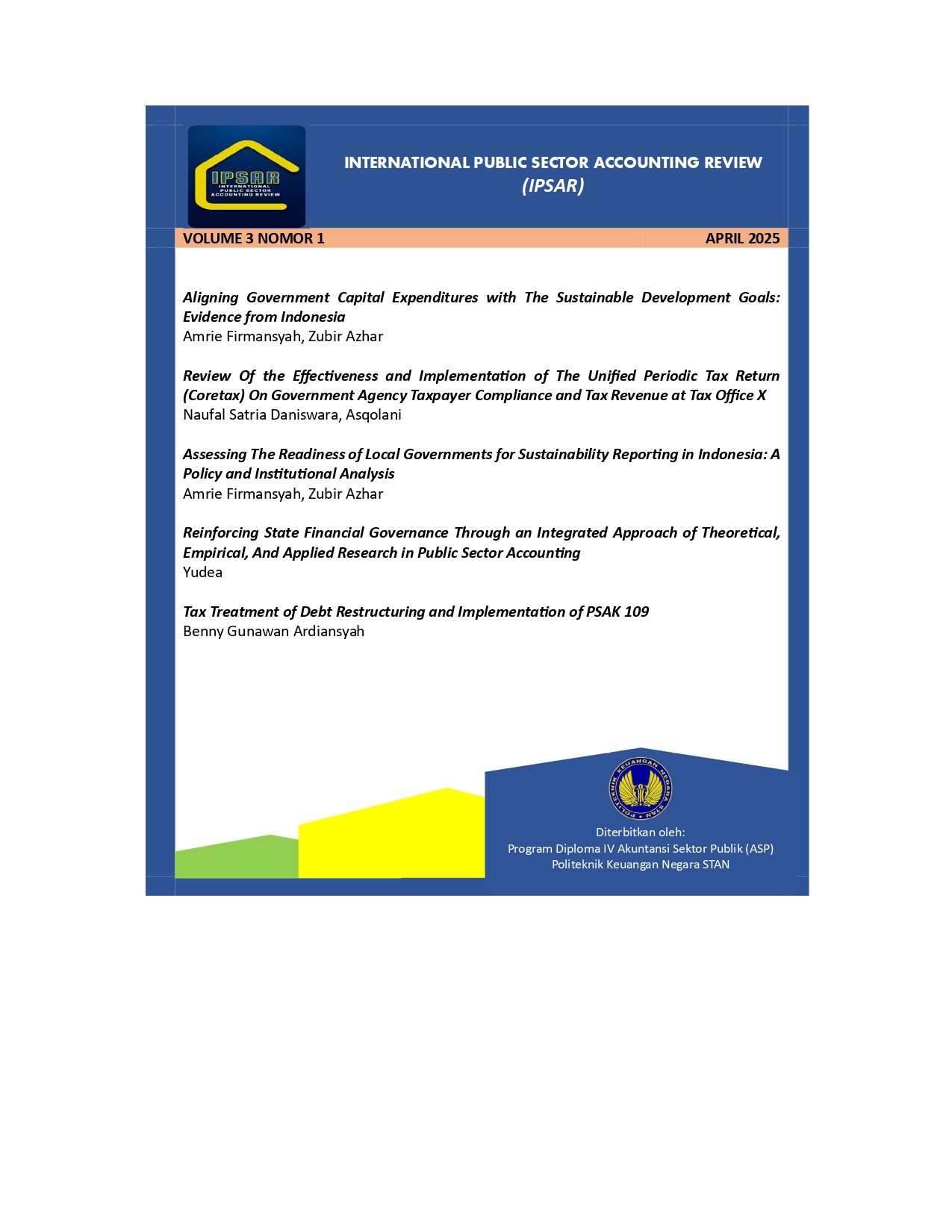
Aligning Government Capital Expenditures with The Sustainable Development Goals: Evidence from Indonesia
DOI:
https://doi.org/10.31092/ipsar.v3i1.3653Keywords:
Government Capital Expenditure, Fiscal Policy, Public Accountability, Sustainable Development Goals, Content AnalysiAbstract
This study analyzes the alignment between government capital expenditure and the Sustainable Development Goals (SDGs) agenda within Indonesia's fiscal policy framework. Capital expenditure serves as a strategic instrument of public finance to enhance infrastructure, stimulate economic growth, and improve the quality of public services. However, its effectiveness depends on the extent to which fiscal implementation reflects the principles of sustainable development. Using a qualitative descriptive approach with content analysis, this study examines official government documents, including the Central Government Financial Statements (LKPP) and the Annual Summary of Audit Results (IHPS) published by the Audit Board of Indonesia (BPK) for fiscal years 2020–2024. These documents are analyzed in relation to the national development framework outlined in the Medium-Term National Development Plan (RPJMN) 2020–2024 and the implementation of the SDGs as stipulated in Presidential Regulation No. 59 (2017). The findings reveal that improvements in efficiency, accountability, or sustainable outcomes have not fully accompanied the increasing allocation and realization of capital expenditures. Audit results highlight persistent weaknesses in project planning, procurement processes, and asset management, which undermine the transformative potential of government investment. Also, while Indonesia's fiscal policy has formally integrated the SDGs, its implementation remains predominantly output-oriented rather than outcome-driven. Strengthening the integration of SDG indicators into budget planning and evaluation, supported by performance-based auditing, is essential to ensure that every rupiah of capital expenditure contributes effectively to sustainable economic, social, and environmental development.
Downloads
Published
How to Cite
Issue
Section
License
Copyright (c) 2025 Amrie Firmansyah, Zubir Azhar

This work is licensed under a Creative Commons Attribution-ShareAlike 4.0 International License.
Creative Commons Attribution-ShareAlike 4.0 International
This license requires that reusers give credit to the creator. It allows reusers to distribute, remix, adapt, and build upon the material in any medium or format, even for commercial purposes. If others remix, adapt, or build upon the material, they must license the modified material under identical terms.